
Advent traditions help us see God’s work in human history
During Advent, the Church invites us into a season of preparation and waiting. Yet instead of slowing down, it often becomes the busiest time of year as we find ourselves immersed in decorating, shopping and social engagements. In the midst of this flurry, it’s easy to miss the mystery of the Advent season.
One of my favorite days of the year is Christmas Eve, where we stand on the cusp of expectation and fulfillment. This culminates with the Christmas Proclamation, a sweeping overview of salvation history chanted or recited before Midnight Mass. Starting with the world’s creation, it relays God’s continual faithfulness to his people expressed through covenants with Adam, Abraham, Moses and David until the fullness of time: Christ’s birth. Understanding God’s work throughout history, we can view our own lives in light of God’s providence.
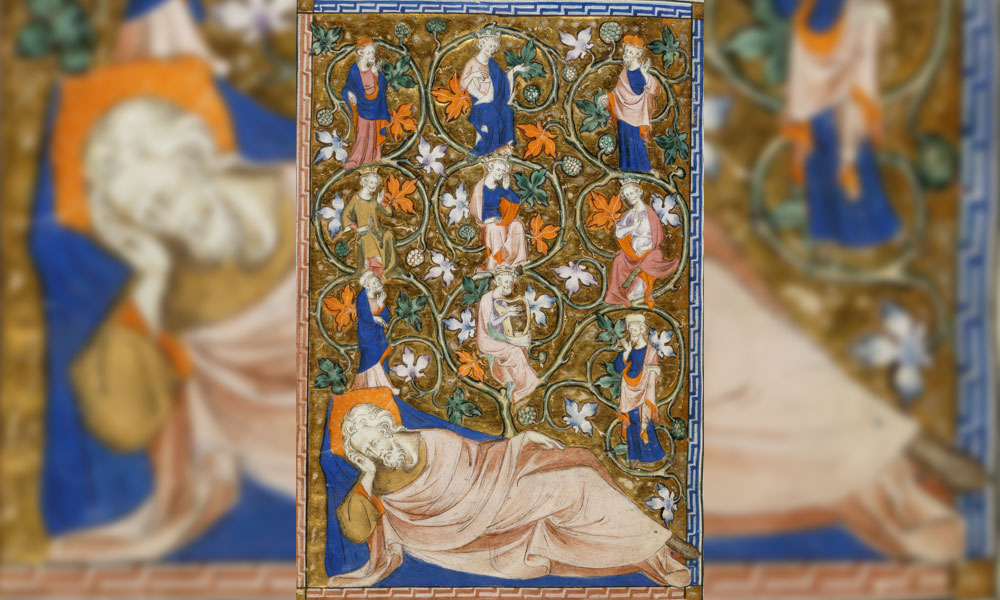
The Jesse Tree
One way to reflect on our place in salvation history in Advent is through the Jesse Tree. Its daily readings trace God’s redemptive work from creation to Noah, Abraham, Jacob, David and the prophets, culminating in Christ. As we hang each ornament – a symbol of the day’s readings – on the tree it visibly reminds us that God slowly accomplishes his plan. The ups and downs of the journey of God’s people is mirrored in our own lives. Through the Jesse Tree, we are invited to reflect on God’s mercy and faithfulness in our failures, moments of grace and challenging seasons.
The Advent Wreath
The Advent wreath also recalls the truth of God’s faithfulness. Each week as we light another candle, the light continues to grow along with our expectation. It teaches us that God’s work is gradual rather than immediate. This is reminiscent of the ancient Israelites who, for centuries, desired to see the Messiah before they died. With each passing generation, the Light of the World grew closer. Our lives, too, are marked with seasons of longing, darkness and waiting. The Advent wreath teaches us it is precisely in these seasons that God actively works in our lives, preparing us for the fulfillment of his promises to us, as he was preparing the world for his coming.
The O Antiphons
Eight days prior to Christmas, the Church expresses her longing for the Messiah by daily asking Christ to “come” through the O Antiphons. Here, with the Church, we echo Israel’s yearning, not only for Christ’s incarnation, but also for him to enter our hearts and satisfy our deepest desires – for the human heart finds fulfillment only in Christ. Each antiphon invokes a specific Messianic title, and ends with Emmanuel – God with us – reminding us that everything reaches fulfillment in him. He remains God with us.
These Advent traditions do more than just prepare us for Christ’s coming. They demonstrate that the God who patiently prepares the world for his Incarnation slowly accomplishes his work in us. Advent, then, a season of preparation, is also one of memory: We trace his faithfulness in our lives through remembering a kind word spoken in affliction, God’s nourishment through his Word and Body, and the moments of grace experienced, even in difficult seasons. The faithfulness of the Jesse Tree, the hope of the Advent wreath and the anticipation of the O Antiphons lead us to the joy of the Christmas Proclamation: that the same God who was faithful to Abraham, Isaac and Jacob is faithful to us. For he is Emmanuel: God with us.
Maria Cintorino holds a degree in theology. Her writings have appeared in several publications including Homiletic and Pastoral Review, Our Sunday Visitor and the National Catholic Register.