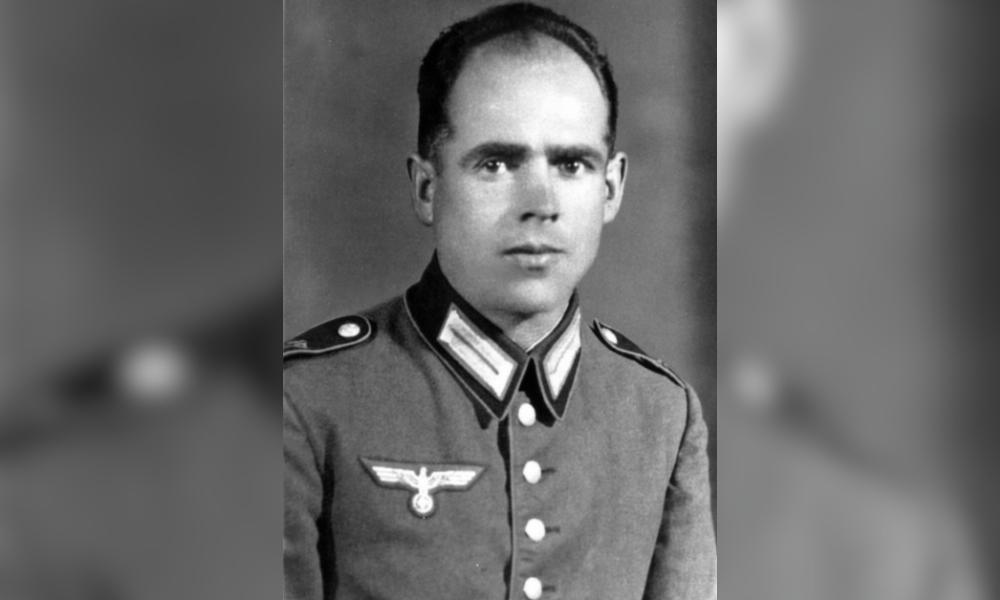
Blessed Franz Jägerstätter
Patron of conscientious objectors - Martyred Aug. 9, 1943 (Feast Day: May 21)
Patron of conscientious objectors - Martyred Aug. 9, 1943 (Feast Day: May 21)
Franz was born in 1907 in St. Radegund, Austria. After his biological father was killed in World War I, his mother married Heinrich Jägerstätter, who adopted Franz as his own in 1917.
Early accounts reveal that Franz had a wild young adulthood: He was fun-loving and popular and became the first in his town to own a motorcycle. Franz was also hot-headed and stubborn: A fistfight with a local soldier earned Franz a short stay in jail.
Franz’s life started to settle down around the time met his wife Fransizka. The two were married in 1936 and traveled to Rome for their honeymoon. During this time, Franz’s faith began to grow, particularly under the influence of his devout wife.
In addition to working on the family farm, Franz became the local sexton at his parish and started attending daily Mass. He refused the customary offering for funerals and instead saw his work of burying the dead as a corporal work of mercy. For a few years, Franz’s life was that of an ordinary, faithful Catholic father and husband. He and his wife had three daughters.
Everything changed in 1938, when Austria was annexed by Germany. Franz was the only citizen in his town to vote against annexation. In 1939, he trained for military service but received a deferment. In June of 1940, Franz was called for military service again but was allowed to return to working on his farm after the mayor intervened on his behalf. After another short term of service, he became convinced that participation in the war was a serious sin. His town priest and even the bishop of Linz urged him not to refuse the draft.
The next call came in February of 1943. On March 1, Franz went to the military office where he refused to take the oath of loyalty to Hitler and to fight, offering instead to carry out non-violent duties – a request that was quickly denied.
Franz was taken into custody and imprisoned in Linz before being transferred to Berlin-Tegel in May. After his trial on July 6, 1943, Franz was sentenced to death by guillotine. Franziska and others wrote many letters, trying to convince him to recant and save his life. Despite their pleas, Franz was firm in his conviction.
As he awaited execution, Franz received the sacraments but turned down offers for spiritual reading, stating that these would only interrupt his communication with the Lord.
Right before his death, Franz wrote; “Neither prison nor chains nor sentence of death can rob a man of the Faith and his free will. God gives so much strength that it is possible to bear any suffering… People worry about the obligations of conscience as they concern my wife and children. But I cannot believe that, just because one has a wife and children, a man is free to offend God.”
Franz went to his death peacefully on August 9, 1943. He was beatified in 2007 in Linz, Austria. Blessed Franz Jägerstätter is the patron of conscientious objectors and is held in high esteem especially among Catholic apostolates focused on peace and non-violence such as Pax Christi and the Catholic Worker Movement.
The importance of conscience in Catholic Social Teaching
Catechism of the Catholic Church 1782
Man has the right to act in conscience and in freedom so as personally to make moral decisions. “He must not be forced to act contrary to his conscience. Nor must he be prevented from acting according to his conscience, especially in religious matters.”
Gaudium et Spes 79
Moreover, it seems right that laws make humane provisions for the case of those who for reasons of conscience refuse to bear arms, provided however, that they agree to serve the human community in some other way.
Compendium of the Social Doctrine of the Church, 399
Citizens are not obligated in conscience to follow the prescriptions of civil authorities if their precepts are contrary to the demands of the moral order, to the fundamental rights of persons or to the teachings of the Gospel. Unjust laws pose dramatic problems of conscience for morally upright people: when they are called to cooperate in morally evil acts they must refuse. Besides being a moral duty, such a refusal is also a basic human right which, precisely as such, civil law itself is obliged to recognize and protect. “Those who have recourse to conscientious objection must be protected not only from legal penalties but also from any negative effects on the legal, disciplinary, financial and professional plane”.
It is a grave duty of conscience not to cooperate, not even formally, in practices which, although permitted by civil legislation, are contrary to the Law of God. Such cooperation in fact can never be justified, not by invoking respect for the freedom of others nor by appealing to the fact that it is foreseen and required by civil law. No one can escape the moral responsibility for actions taken, and all will be judged by God himself based on this responsibility (cf. Rom 2:6; 14:12).
Pope Leo XIV, Magnifica Humanitas 192:
“Today more than ever, without prejudice to the right to self-defense in the strictest sense, it is important to reaffirm that the “just war” theory, which has all too often been used to justify any kind of war, is now outdated…”