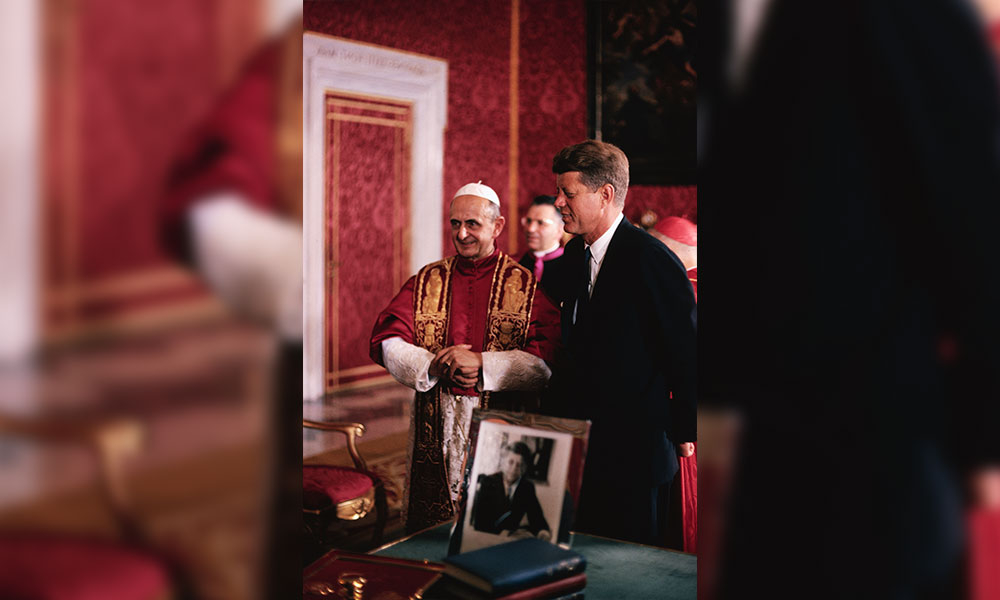
The fourth document of Vatican II Gaudium et Spes
Pope Paul VI promulgated Gaudium et Spes (The Pastoral Constitution on the Church in the Modern World) on Dec. 7, 1965. It was the last of the four constitutions produced by the Second Vatican Council. Unlike the two dogmatic constitutions (Lumen Gentium and Dei Verbum) which addressed the unchanging truths of the faith, Gaudium et Spes sought to apply dogmatic truth to modern life.
Attuned to the signs of the times
The fundamental premise of Gaudium et Spes was captured in its iconic opening sentence: “The joys and the hopes, the griefs and the anxieties of the men of this age, especially those who are poor or in any way afflicted, these are the joys and hopes, the griefs and anxieties of the followers of Christ.” (1) For the Second Vatican Council, solidarity, the Catholic principle that all people are part of one human family, was the foundation upon which the Church’s pastoral approach to the modern world must be constructed. Instead of viewing the secular world with suspicion, the Council Fathers affirmed that the Church must walk alongside humanity, reading the “signs of the times” in light of the Gospel to better serve it. (4)
Equally important to this constitution’s vision was an emphasis on the unique dignity of every human being as created in the image of God. Because of this reality, Gaudium et Spes asserted that human beings find their true identity through a “sincere gift of self” (24) rather than through radical individualism or state collectivism. It also presented Christ as the ultimate revelation of what it means to be human: “Christ, the final Adam, by the revelation of the mystery of the Father and His love, fully reveals man to man himself.” (22)
A Church engaged in the world
Several important shifts in how Catholics should engage modern society issued forth from this vision. For example, Gaudium et Spes moved the Church from a stance of protective isolation against the evils of the secular world to a stance of engaging in society and seeking to transform it with the values of the Gospel (see 63-65). While it acknowledged that science and culture have their own methods and autonomy, it called on the Church to engage with issues such as nuclear war, poverty, economic justice, technology and political participation with an eye to the common good.
In doing this, Gaudium et Spes also elevated the role of lay Catholics. Engagement with the world was to extend beyond the clergy. Lay Catholics were called to transform secular institutions through their lived faith and an unwavering commitment to an inviolable human dignity.
In addition, the constitution introduced a significant shift regarding the theology of marriage (48-50). In Gaudium et Spes, the Second Vatican Council moved away from rigid contractual language in describing marriage to interpersonal covenant language. Marriage was to be understood not simply as a legal arrangement, but as a covenant of life and love, a reflection of Christ’s own total self-giving and union with the Church. Marriage, properly ordered, was to be both procreative and unitive.
An enduring pastoral paradigm
The world Gaudium et Spes confronted in 1965 was one of rapid growth in technology, shifting social norms and the threat of nuclear war. In response, it offered a message of solidarity. While it did reject a progressive secularism that tended at times to minimize sin, orthodox doctrine and the necessity of salvation, it did not treat the secular world as entirely hostile.
The impact of this constitution is most clearly seen through the teachings of subsequent popes. In his Theology of the Body, St. John Paul II often referenced paragraph 24 of Gaudium et Spes to ground Catholic sexual ethics in the total gift of self. Pope Benedict XVI reinforced the constitution’s call to balance faith and reason in public life. His 2009 encyclical, Caritas in Veritate, takes up and further develops many themes we see in Gaudium et Spes. And Pope Francis, throughout his papacy and in his many writings, frequently drew on the constitution’s emphasis on accompaniment, solidarity and care for the poor. Today, it remains an essential reminder that Catholics are called to engage the world in which they live with unwavering fidelity to Christ and a loving, open heart toward all humanity.
Pope Leo XIV Catechesis on Vatican II
On Sept. 2, 2026, Pope Leo XIV began his catechesis on Gaudium et Spes during his Wednesday audiences. Pope Leo recalled how the posture of the Church toward the world is rooted in Christ’s own sharing in our humanity: “A sharing that calls on us to leave behind all passivity and indifference in the face of current events, history and people’s lives, especially in the face of the rapid and profound changes we are experiencing today. We cannot remain as unengaged spectators; rather, we must listen with our hearts, allow ourselves to be challenged, and become involved.” On Oct. 7, 2026, Pope Leo added that “the Church is not ‘above’ or ‘beside’ the world, but is, as it were, grafted into it.” Gaudium et Spes, he continued, “reserves special mention (43) for the mission of the lay faithful who, by virtue of their baptism, are called to enliven the world with the vision of the Gospel.”
Did You Know…
From A Concise Guide to the Documents of Vatican II: “Gaudium et Spes was the only Council text composed entirely in a modern language, French. While it was translated into Latin for debate in the council hall, bishops were provided with versions of the text in the main European languages. This had not been done for any of the other documents.” (Hahnenberg, 70)
Doug Culp is the chief operating officer for the Pontifical Mission Societies of the United States.